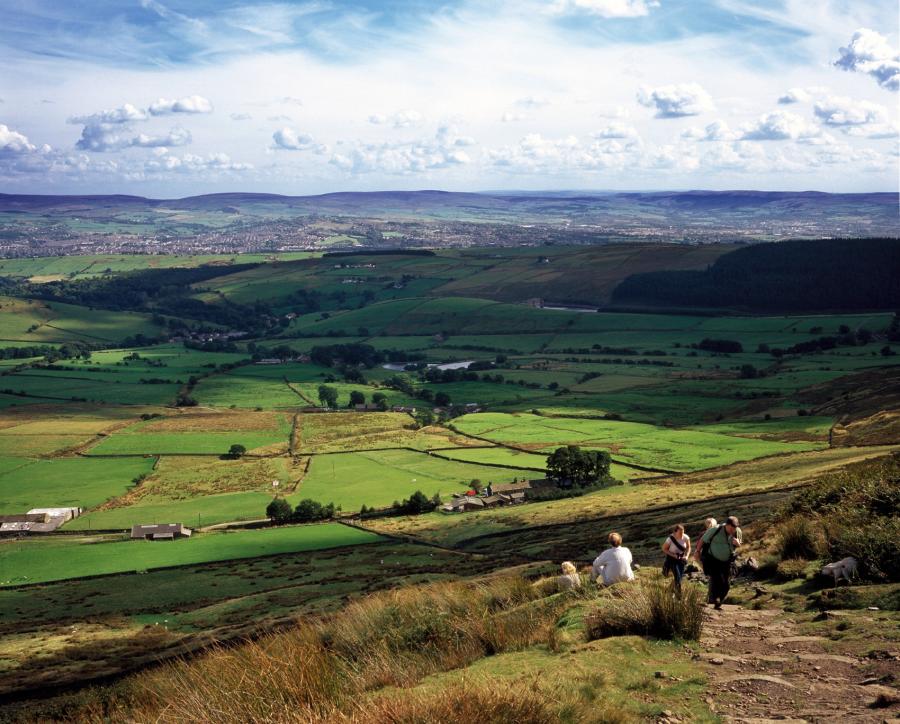
The Forest of Bowland landscape is, and will continue to be, the result of a close interplay between natural processes and active, human management. Climate change and the biodiversity crisis will further affect the fundamental character of the Forest of Bowland landscape. The following section highlights key areas where change, both positive and negative, is likely to impact the landscape. It incorporates the main considerations identified within the current Forest of Bowland Landscape Character Assessment.
Changes in agricultural practice and wider land management
Pressures
- Agricultural specialisation, intensification, drainage and farm amalgamation potentially leading to a loss of biodiversity, landscape and cultural features, resulting in landscape character change.
- Potential increase in invasive species such as bracken and gorse and the resulting landscape change.
- Loss of traditional skills and/or lack of management threatening traditional landscape features such as drystone walls, sheepfolds, hedgerows and woodlands.
- Pressure for new infrastructure including access tracks, shooting butts and cabins could lead to effects on the landscape.
- Change of crop types has the potential to change landscape character, particularly if there is a change to biomass or other visually distinct crop types.
- Increase in pheasant and partridge rearing, feeding and shooting on increasingly higher land – introduction of pens and feeding stations.
- Pressure for more commercial forestry and tree planting.
Opportunities
- Grant aid and incentives for habitat restoration and creation.
- Involvement in agri-environment programmes.
- Sharing good practice through peer support networks.
- Training opportunities building skills and confidence.
- Management of moorland habitats and ecosystems, including peatland restoration.
- Opportunities to consider succession for mature ‘Landmark Trees.’
- Opportunities to increase tree and woodland cover to reconnect fragmented habitats.
- Opportunities to restructure commercial forests through phased felling and restocking and the use of native broadleaves to assist in improving landscape value, whilst retaining commerciality.
Climate Change
Pressures
- Increased risk and frequency of flooding.
- Increased risk of moorland fires.
- Potential increase in soil erosion due to sudden downpours and weakened soil structure.
- Hotter, drier summers, leading to reduced ground water and drying out of peat bog habitats, affecting the character of upland landscapes and the preservation of buried archaeology.
- Changes to species composition and layout affecting the historic value and sense of place of designed landscapes.
- Potential change to cropping patterns and types of crops.
- Patterns of usage of footpaths and bridleways may change, with a potential increase or decrease in demand.
- The risk of the spread of invasive species.
Opportunities
- Grant aid and incentives for habitat restoration and creation, helping to maintain key landscape components such as peatland, species-rich grassland and woodland.
- Nature-based solutions to flood management.
- Availability of private finance and investment to support habitat restoration and management.
Development and Recreation
Pressures
- Inappropriate development of farm buildings and barns affecting the character and use of the landscape.
- Pressure for larger scale residential development, including areas of infill or on the edge of existing towns and villages, within and close to the boundary of the National Landscape.
- Increased pressure to accommodate large scale renewable energy schemes, such as solar, wind and energy storage, impacting the National Landscape or its "setting".
- Increase in inappropriate lighting within, and at the boundaries of, the National Landscape, with potential effects on dark night skies.
- Development of infrastructure associated with the water supply industry, which has potential landscape and visual impacts.
- Pressure at key visitor destinations resulting in erosion, effects on landscape features and tranquillity, loss of habitats, potential damage to archaeological sites, litter, overspill parking and diminished visitor experience.
- Erosion of sensitive peatland through unregulated access on open access land.
- Increase in visitor numbers is likely to increase traffic and congestion, which may affect tranquillity and also lead to conflict with other recreational uses of the area.
- Increasing traffic pressures on minor rural roads associated with increased visitor numbers, may require increased signage, road improvements and implementation of traffic restrictions.
- Pressure for lodge, caravan and camping accommodation related to increased tourism could give rise to landscape and visual effects.
Opportunities
- Sympathetic design of new buildings, and conversion of historic buildings, in keeping with the local vernacular of the landscape, with appropriate materials, siting and screening.
- Opportunities for the sensitive management of ‘honeypot sites’ to enhance the visitor experience and benefits.
- Sensitively designed visitor accommodation and facilities.
- Appropriately designed signage and highway improvements and/or the use of innovative visitor and traffic management approaches.
- Potential for renewable energy micro-generation including hydro and roof-top solar where appropriate